
The Round-Up #5
Neanderthals, male birth control, new clinical trial models, biology comics, and more!

Welcome (back) to The Science Fictional Now! We’re back again with a list of the most interesting and informative things I read or listened to the past few months. Let me know what you enjoyed the most in the comments. Some miscellaneous items to get us started:
Of Neanderthals and men: The New York Times’ Daily podcast recently did a wonderful episode on neanderthal paleogenetics. Give it a listen to find out what modern biology has taught us about these erstwhile hominids and stay for some reflections on speciesism and human exceptionality at the end.
Genetically engineered blackberries: The Economist published a new article on Pairwise, a company commercializing CRISPR-edited foods. There’s not a ton of new info here for those of us who have followed Pairwise, but I’m linking to the piece anyway because I think it’s interesting how pro-genome editing it is. This increasing positivity from the business press (ahead of the “public”) matches a trend that I observed during a recent historical project on genetically engineered bacteria in the ‘80s. The appetite is probably spreading too: the EU recently altered its policy on plants engineered with “new genomic techniques,” meaning that many CRISPR-edited plants won’t be considered GMOs going forward.
FDA and clinical trials
Male birth control: Annalisa Merelli had a fascinating article in STAT about forthcoming male birth control methods. There’s an unusually strong social thread for the biotech trade press here, likely due to the subject matter.
Scaling personalized CRISPR medicines: Amy Feldman wrote a piece for Forbes about a new company called Aurora Therapeutics, aimed at editing away rare genetic diseases. Founded by genome editing pioneers Fyodor Urnov and Jennifer Doudna (my former boss), the company hopes to scale the approach used to treat “Baby KJ Muldoon” for CPS1 deficiency last year. This will take advantage of FDA’s new “plausible mechanism” pathway announced last November. I’m curious to see how widespread this approach becomes within clinical-stage genome editing, which has seen widely-acknowledged commercialization issues.1
Genetic surgery, regulatory edition: a16z’s Jorge Conde outlined another regulatory proposal called the “SAGE Framework,” which essentially treats genome editing more like genetic surgery. I found it pretty interesting to think through, with my main worry being that adapting surgical risk assessment to genetic medicine would be quite difficult.2
Bayes goes medical: FDA also recently declared its openness to Bayesian statistics in clinical trials. I found Peter Doshi’s analysis for the BMJ informative.
Prasad departure #2: And now, for the news the FDA wonks among you were waiting for after reading the title of the section. Calling Vinay Prasad controversial would be the understatement of the decade, even before recent controversies over trial rejections for Moderna’s mRNA flu vaccine and uniQure’s Huntingdon’s gene therapy. See BMJ and CNBC.
GLP-1 history: Alex Kesin and Matthew Pech started a new podcast called Approved, featuring a great debut episode on Amylin Pharmaceuticals. Amylin went defunct in 2014 but not before commercializing the first GLP-1 agonist drug (exenatide/Byetta). Their blockbuster movie-length second episode on Geron came out literally while I was writing this Round-Up.
Other science/government and funding
New fetal tissue research restrictions: NIH Director Jay Bhattacharya announced in January that the agency would cease funding research using fetal tissue from elective abortions. See coverage from Nature news and Paul Knoepfler’s take. This issue has become a biomedical Mexico City Policy, where the government’s position corresponds to the President’s party. I’m not a fan of the restriction, but my bigger worry is the precedent that it’s set for regression on embryonic stem cell (hESC) policy, which has an active RFI until April. Both the fetal tissue restriction and hESC RFI are couched in the language of “modernization,” which I find disingenuous as it weaponizes a respectable goal as cover for what is obviously anti-abortion policy.
Federal sience funding in 2026: The Office of Management and Budget has been slow to release certain research funds (from already heavily slashed agency allocations), report Max Kozlov, Alexandra Witze, and Dan Garisto for Nature news.
Billionaire $ ok?: On a related note, Lucas Harrington has an interesting blog post where he argues that funding from wealthy individuals benefits science. I disagree with a lot of what’s written here; private funding historically producing useful science does not signal the comparative utility of that system, and I don’t think he actually demonstrates that private capital “has an outsized ability to identify and support breakthrough research.” However, I agree that more money flowing into science overall is a good thing, especially with the current science policy climate. I encourage you to treat his post as a starting point for thinking about how private funding might be best disbursed and utilized, and how public funding might be reformed in the future.
Biosecurity
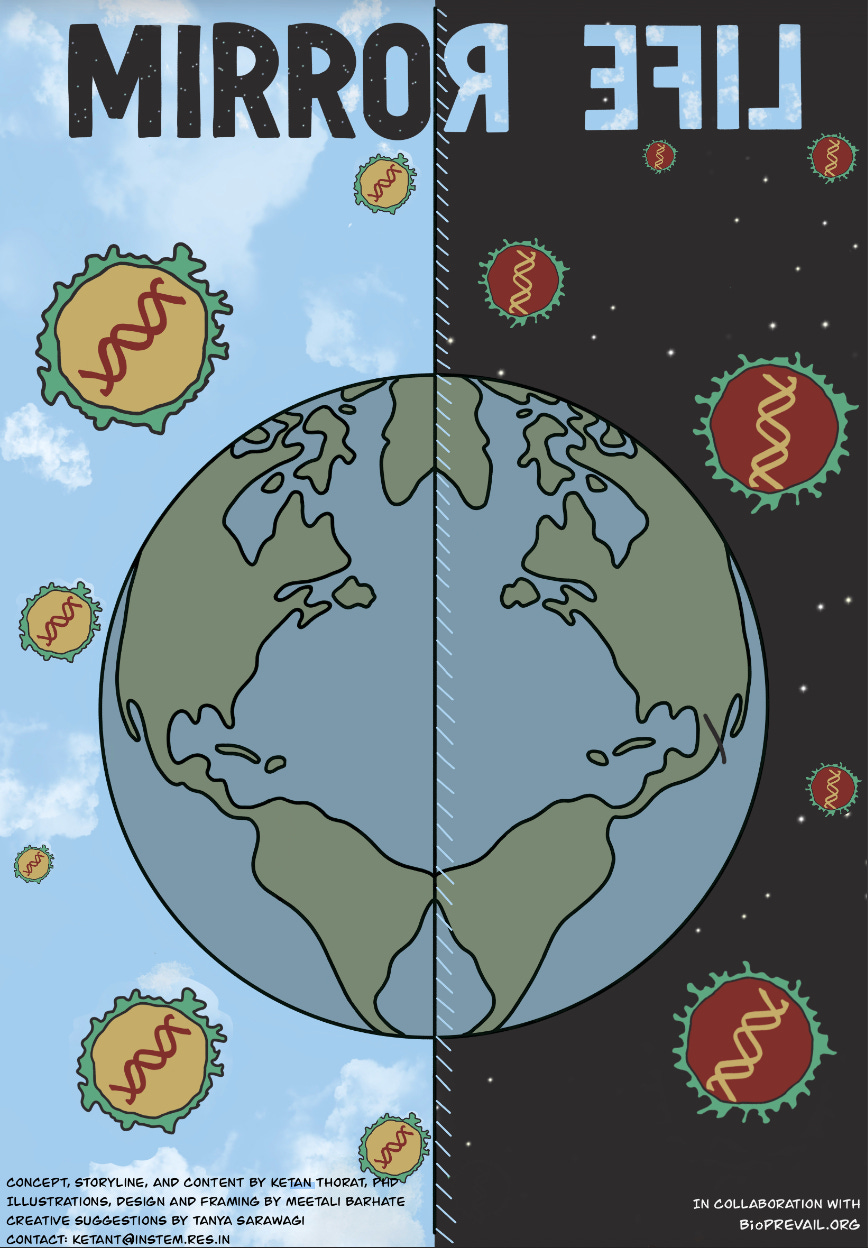
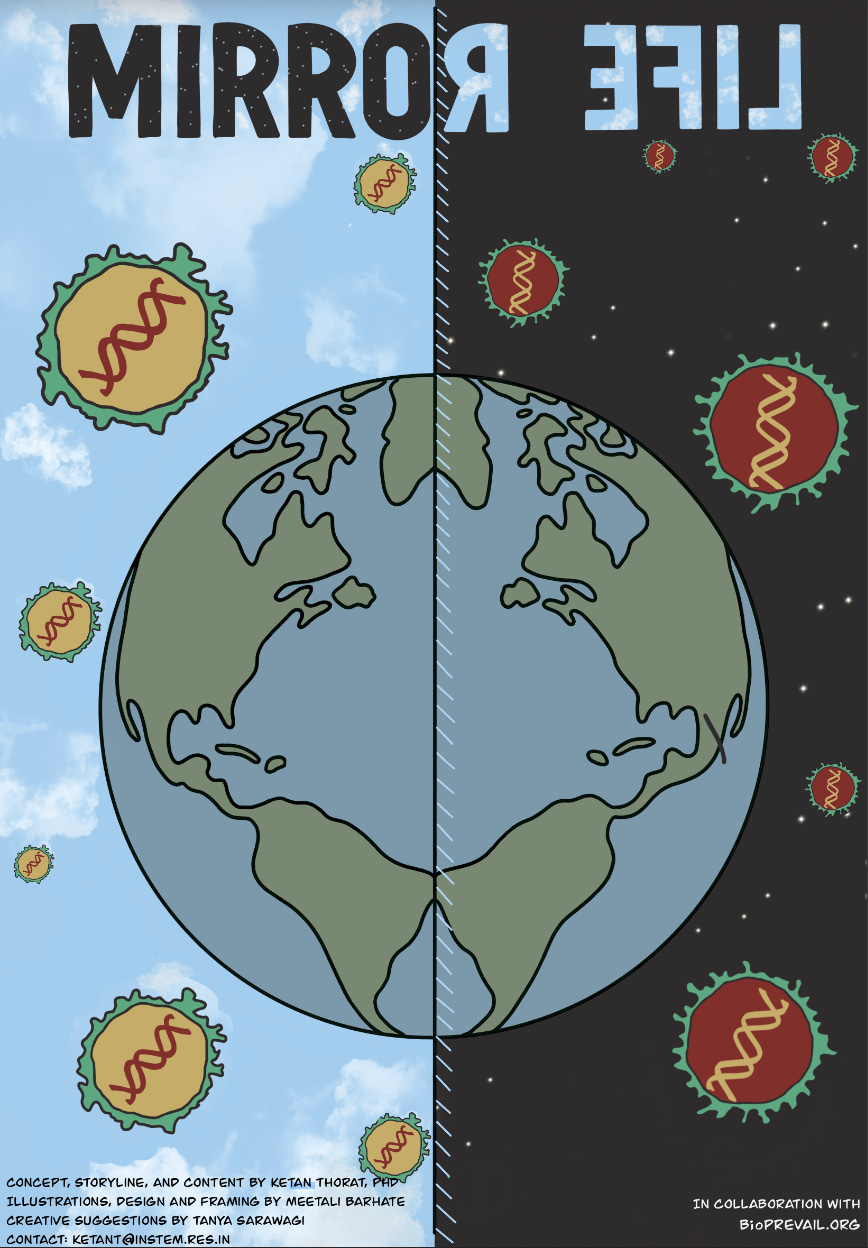
Chiral comics: The biosecurity sections of these linkposts often get a bit harrowing, so let’s start on a high note. Ketan Thorat, Meetali Barhate, and BioPREVAIL have a fun short comic on mirror life!
Data access: A group of biosecurity researchers recently published a policy article in Science outlining a framework for restricting access to certain types of sensitive data, such as eukaryotic viral proteins and toxins. We’ve discussed proposals to build safeguards into biological design tools themselves in previous Round-Ups; this is a complementary approach. A few days ago, the Johns Hopkins Center for Health Security published a report outlining how this could be implemented at the federal policy level.
LLMs and learning bio fast: Stephen Turner has a nice Substack post on two recent preprints assessing how much “uplift” LLMs provide to novice biologists attempting to do biosecurity-relevant workflows. In short, the models are much more helpful for computational biology than lab tasks. I do wonder how well the likely well-meaning participants in these type of RCTs represent the tenacity of real-world bioterrorists.
New scientific papers
Programmable recombination is heating up: In previous Round-Ups, we’ve discussed new “cut and paste” methods of genome editing enabled by recombinase proteins. In 2026, this approach has really heated up. Oana Pelea et al. from Martin Jinek’s lab at the University of Zurich showed that bridge recombinases3 work in human cells, complementing an earlier demonstration. Connor Tou et ali. from Ben Kleinstiver’s lab at Massachusetts General Hospital created new single stranded DNA templates, which they were able to efficiently insert with several types of programmable recombinase.
At long last: Two very interesting papers we covered as preprints have now been published in Nature. CRISPR-guided transcription and the DNA language model Evo2. The Arc Institute has really put a lot behind their model: check out the videos on this thread.
4D cell simulation: Zaida Luthey-Schluten’s lab at the University of Illinois published a paper in Cell this week describing a full simulation of a cell through its ~100 minute lifetime. Specifically, they used a “minimal” synthetic cell created by the J. Craig Venter Institute as a tractable model. You can imagine a certain section of the media really running away with this one, but thankfully Niko McCarty has a very level-headed and readable explainer of the paper.
Bacterial virus infection, visualized: Nicholas Taylor’s lab at the University of Copenhagen put out a really nice preprint showing how the famous (at least among microbiologists) bacteriophage T4 injects its genome into unsuspecting bacterial cells. First author Aritz Roa posted a great video of the whole process on X.
Twist and unwind: My friend and former colleague Zehan Zhou led work on a recent preprint that tracked the tiny movements made by genome editors while unwinding strands of DNA. I should note that this is technically self-promo since I’m a co-author, but all the credit goes to Zehan and the other authors. There’s a lot of complex biophysics going on here, so center yourself by looking at the crazy rotor bead apparatus that they used to study molecular movement (Fig. 5). Seriously one of the coolest techniques out there.
The rare disease regulatory pathway is already quite interesting due to it's “exceptionality” - getting a rare disease treatment approved gives a company extra market benefits and oftentimes requires less statistical evidence than normal. I went to a reading group this week discussing this relevant chapter, which discussed how the rare disease area has become a trial space for companies to test new general strategies towards regulatory reform. This is important to understand if you’re curious about how the new regimes discussed above might play out.
I actually found this use of “gene surgery” quite funny as it’s a radical departure from how that term is used in the genome editing ethics/social studies literature. For example, anthropologist Eben Kirksey preferred “gene surgery” to “genome editing” because the former better conveyed the risks associated with using CRISPR in humans.
For a more in-depth explanation of the tech, see this article I wrote last May.