
The Roundup #1
A breakthrough in genome editing, an Enhanced Games update, The Acolyte, and more

Welcome (or welcome back) to The Science Fictional Now!
I started this Substack to be a place where I could simply share my thoughts on topics of any size that interested me. Thus far I’ve mostly tackled topics in the medium-to-large range, writing in detail about a single topic in each post. However, I’ve also wanted to be able to write about news stories, research articles, pieces of fiction, and whatever else catches my eye. So, from time to time, I’ll be making “Roundup” posts such as this one and discussing a vide range of topics relevant to the themes of this Substack.
Again, I’m not looking to become a ‘content creator’ here, so these Roundups will come only as often as I have enough interesting material to write them. They’ll be largely free-form, with a variable structure and more words dedicated to some topics than others. I’ve grouped today’s post into three ‘buckets’: research, science in society, and science fiction - let’s get started.
Research
A new frontier in genome editing?
There was a time when CRISPR was a little-known system used by bacteria to defend against invading viruses, but over the past decade it’s evolved into one of today’s most recognizable biotechnologies and become synonymous with genome editing. The most CRISPR system consists of a protein (more specifically, an endonuclease) called Cas9 that cuts DNA, and ‘guide’ RNA molecule that directs Cas9 to cut at a specific DNA sequence. Thus, by working in conjunction with the cellular DNA repair machinery, CRISPR-Cas9 can produce an edited sequence.
Earlier this week, however, two papers in the prestigious scientific journal Nature described a new system allowing not only for sequence-specific DNA cleavage, but the insertion of specific DNA sequences. The system consists of a ‘bridge RNA’ that binds both a DNA target site and a second sequence to be inserted, as well as a recombinase protein that carries out the edit. The bridge RNA system has already allowed researchers to perform insertions, deletions, and inversions of long DNA sequences, all without having to rely on the aforementioned cellular DNA repair machinery.
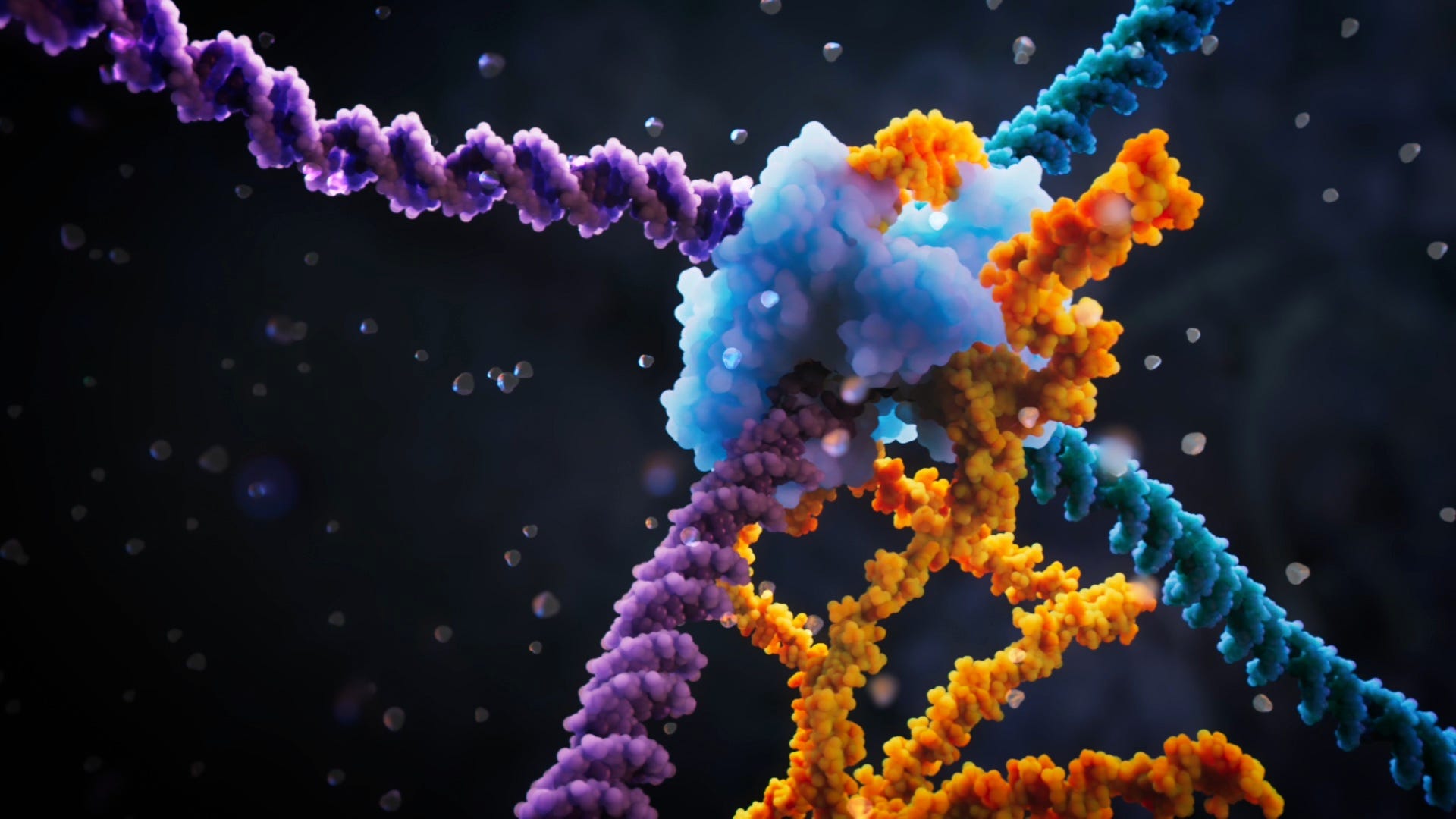
The bridge RNA system seems poised to push the genome editing field to new heights, but its recent characterization means that a number of questions persist. Its conceptual novelty and performance in test tubes are undeniable but the system’s efficacy in mammalian cells has yet to be determined. If you’d like to know more about the bridge RNA’s mechanism and implications, check out the reader-friendly Nature news article released alongside the scientific papers.
Talking to people about CRISPR, I’ve often encountered the assumption that Cas9 ‘solved’ genome editing and I don’t really think this is the case. In my last post on this Substack, we discussed the biochemical diversity of Cas proteins as a strength of the genome editing field and I think the discovery of the bridge RNA system provides even more evidence for this view. New RNA-guided endonucleases such as TnpBs and Fanzors have been discovered in recent years, and the bridge RNA demonstrates that there may be more systems out there with mechanisms we haven’t even seen yet. We just have to know where to look.
The AlphaFold 3 controversy
As many of you are likely already aware, one of the biggest innovations in biology over the past few years was AlphaFold, the machine learning-based tool that has allowed biologists to predict protein structures with much higher accuracy than previous methods. The newest version of the model - AlphaFold 3 - was released by Google DeepMind last month, further expanding its functionality but also igniting a controversy.
Solving a protein structure typically yields highly detailed information about its function and biochemical mechanism, but lab-based techniques for this process are time-consuming and require considerable skill. To overcome this challenge, computational biologists have written programs to predict proteins’ structures solely from their amino acid sequences. AlphaFold did not ‘solve’ the protein folding problem as the news media have often claimed, but the model has led to significant improvements over existing methods, announcing the arrival of machine learning to biology in the process.
AlphaFold 3’s release was announced via a research publication in Nature, but DeepMind elected not to release the model’s full code and weights. Since Nature typically requires the publication of such information, a number of scientists criticized the apparent double standard, with Swedish biophysicist Erik Lindahl even calling the paper “an ad for commercial services.” Researchers quickly penned an open letter to Nature requesting the release of this information, garnering over 650 signatures online. While DeepMind has committed to releasing the model for academic use within six months, today AlphaFold 3 remains accessible only via DeepMind’s web server, with users limited to 20 inputs a day. Open-source implementations are under development by the computational biology community, but none have been able to match the proprietary model’s performance thus far.
Science in society
CRISPR salads
In a few months, we’ll all be able to walk to the grocery store and buy mustard greens made to taste better by CRISPR genome editing. We all already eat genetically-modified foods every day, but my guess is that contemporary genome editing techniques will become increasingly prevalent in commercial agriculture due to the streamlined modification process that they offer, with desirable changed being made through small edits in plants’ own DNA rather than the introduction of exogenous genetic material. It looks like CRISPR’s arrival to the supermarket won’t be marked by as much fanfare as its entry into the clinic was, but I’m intrigued nonetheless to see how such products are received. Read about it more in WIRED.
The Enhanced Games goes to Rogan-town
My first post on this Substack was an in-depth essay on the bioethics of the Enhanced Games, an upcoming Olympic-style sporting event where athletes will be allowed to use performance enhancing drugs. The Games’ founders recently went on Joe Rogan’s podcast to discuss the venture, so I figured it was time for an update. I have far too many thoughts to construct a narrative that is both coherent and concise here, so I’ll just include a few in bullet-point format. All observations below are from the podcast unless otherwise noted; an AI transcript can be found here.
Since my essay primarily focused on the bioethical questions surrounding the Enhanced Games, I didn’t have much space to dive into their founders’ criticism of the Olympics’ business model. The Games’ appearance on Rogan’s podcast was well-timed in the sense that the recent stories about Chinese swimmers competing in the Olympics after multiple positive drug tests as ammunition. That said, it could have been even better-timed as top swimmers testified before Congress earlier this week, expressing little confidence in the current Olympic testing regimen. I’m sure the Enhanced Games will look to capitalize on any further Paris Olympics controversy, and I do think they’ve identified legitimate issues with the competition. Whether or not their event is the antidote, however, I’m less sure.
The Enhanced Games has updated their website since I wrote my initial essay and their rhetoric, which I generally took issue with, seems to have been moderated to some degree. While the “How to Come Out as Enhanced” page on their website is still live, it doesn’t appear on their drop-down menus anymore. The Games’ team has also expanded, notably to include a Director of Athlete Safety. I think this is a good sign, but I’m not totally convinced that the Founders are really as pro-athlete as their words suggest - more on this in a minute.
One of the most interesting aspects of the podcast to me was the clear differences in style between the two founders. The Games’ architect Aron D’Souza was prone to hyperbole and the muddling of details while his co-founder Christian Angermeyer seemed somewhat more clear-eyed. This wasn’t entirely surprising to me, as I’d previously noticed differences similar differences in their willingness to compare the struggles of enhanced athletes and the LGBTQ+ community. Here are a few examples from the podcast to illustrate what I’m talking about:
D’Souza claimed early on that 44% of Olympic athletes have used PEDs in the last year - a statistic that also appears on the Enhanced Games website. While the study he cities is pretty damning, it was not conducted at the Olympics. Moreover, D’Souza’s language is full of flippant superlatives (’the best medical journals’, ‘the top venture capitalists’, etc.). I realize that I’m splitting hairs here, but you’d expect a guy who keeps talking about ‘rigorous research’ to be have some attention to detail.
Angermeyer, by contrast, seems to understands the FDA approval process and the characteristics of rigorous clinical research more. Like many venture capitalists and entrepreneurs, he seems prone to overselling, but I’m much more convinced he’s speaking in good faith than D’Souza.
At the end of the day, though, the Enhanced Games don’t get to simply choose where their data are published: it’s the journals themselves who have the final say. I think it would be great if the event yielded informative results, but the Games’ decision to allow athletes to take whatever substances they want will make meaningful comparisons difficult.
More than anything though, I wish D’Souza and Angermeyer were willing to acknowledge the complexity of the whole situation. They’re hardly willing to engage with other ideas and seemingly don’t want to acknowledge the potential trade-offs between individual choice and safety. As much as they want to be ‘disruptors’, they also don’t want to admit that their ideas are new and act like they don’t need to justify themselves to anyone. The fact that the founders take themselves so seriously almost certainly leads other people to trust them less.
One question that was constantly on my mind while writing my initial essay was the amount of performance enhancement possible through PEDs. D’Souza said the Games’ scientific team has an estimate of 5%, though it wasn’t exactly clear what the baseline for this number was. Even if he meant that athletes at the Games will get an additional 5% over existing PEDs regimens undetectable by drug test, it seems that only truly elite athletes will have any shot at breaking world records any time soon. In fact, D’Souza seemingly went on to suggest that Enhanced Games athletes will benefit more from the increased pay the Games will net them than PEDs.
Of course, D’Souza and Angermeyer also stated that they hope that the Games will spur the development of better PEDs in the future, which could partially ameliorate this tension D’Souza claimed that nations will driven to do this by the desire to be seen as technologically advanced, though he also confusingly stated that “the era of nationalism is over”. I’ve previously written in detail about how the goals of the Enhanced Games go beyond sports into bigger hopes about human enhancement. Even if better PEDs have spillover therapeutic benefits, I’m skeptical that competition to develop them would produce equitable or even particularly noteworthy gains for human health overall.
Science fiction
Space looks slimy to Philippe Druillet
This past month, I was finally able to dive into the work of Philippe Druillet, the French cartoonist best known for his comics featuring the spacefaring picaro Lone Sloane. While it wasn’t the first volume to feature the character, Delirius was the book that first got me interested in Druillet’s work, so I decided to make it my starting point.
Frankly, the story failed to impress me: I found the pacing too fast, the dialogue flat, and the structure largely derivative of traditional heist stories. In fact, my issues with Delirius’ narrative bore remarkable similarity to those I took with the last Franco-Belgian science fiction comic I read: Alejandro Jodorowsky’s The Incal. Two books is of course a small sample size, but I’ve begun to wonder if I’m reacting to things characteristic of a larger tradition rather than any individual author or translator. But while it felt like there was never a panel where something new didn’t happen, the art contained with the panels themselves blew me away. Just look at this full-page spread, for example:
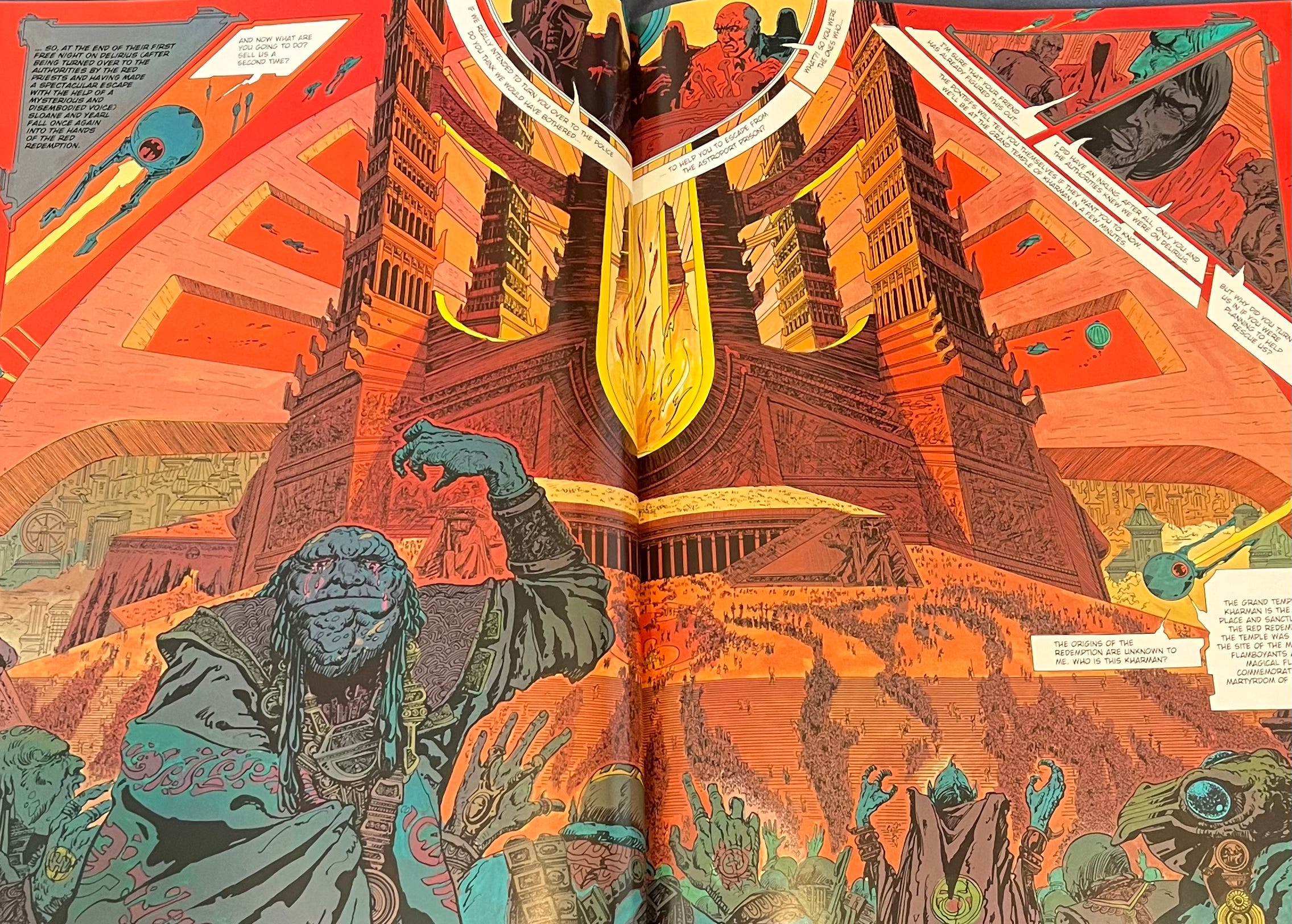
In her wonderful biography of the existentialist philosophical movement At the Existentialist Café, Sarah Bakewell memorably noted that “Sartre, if we can judge by the vivid descriptions in his books, found sex a nightmarish process of struggling not to drown in slime and gloop” (124); this seems to be how Druillet sees not just sex, but everything we do. Delirius doesn’t look to mirror the way things look right now or even how they’ll probably look in the future - instead, it strives to capture how things feel.
It’s likely no accident that Druillet’s work led me to recall Sartre; the former’s work seems undeniably tinged with existentialist thought, with the masses of Delirius controlled through vice rather than set free by it and Lone Sloane himself as Camus’ absurd man. Sloane is no hero, however, and his insistence on demonstrating the futility of meaning-seeking renders him a mostly amoral rogue rather than someone deserving of our admiration. I’ve become curious about the evolution of picaresque characters in science fiction, so I’ll likely be reading more Lone Sloane soon. I’ve heard that many of Druillet’s other Lone Sloane stories have narrative complexity to match the detail of his art, so I’m hopeful that at least one of them will really be firing on all fronts.
The history of The Eternaut
While we’re on the subject of mid-century science fiction comics…
One of my favorite YouTubers, the memorably-named Matt, recently put out this fascinating video about Argentine comic legend Héctor Germán Oesterheld, who was best known for writing the science fiction masterwork The Eternaut. Matt delves into Oesterheld’s pre-Eternaut work and discusses how his work and activism made him an enemy of multiple oppressive regimes in his home country. Oesterheld’s story bridges the literary and the political, inviting us to think about the nature of adaptation, the potentially radical nature of imagination in science fiction, and the broader political situation of Latin America in the latter half of the 20th century.
Let’s talk about The Acolyte
If you’ve spent much time on the internet over the past month, chances are you’ve encountered harsh criticism, shall we say, of the latest Star Wars TV show, The Acolyte. I think the controversy is quite overblown and don’t want to give it more time than it’s worth, but it’s illustrated existing problems with how people engage with Star Wars and science fiction in general that I think deserve some discussion.
With that said, I don’t feel obligated to spend time breaking down and responding to specific online reviews because I’m convinced that most people who are criticizing this show so harshly are not doing so in good faith. ‘Bad writing’ has effectively become an internet dogwhistle, and I find it hard to believe that people barely willing to say a single good thing about this show ahave given it a fair chance. I’m not saying people need to like the show, but the fact that online commenters have felt the need to imply that anyone who does is either a bot or paid by Disney is strange to me.
What I will do here is make an appeal to more reasonable Star Wars fans to engage with the show (and the rest of the franchise) beyond just the surface level. Many commenters have criticized the show for not sufficiently adhering to established Star Wars lore; much of this criticism also seems to be broad and in bad faith, but some have seized on two particular examples that I think demonstrates a lack of understanding. In the fourth episode of the show, Jedi Master Ki-Adi-Mundi made a cameo appearance despite his Star Wars Legends birth date being after The Acolyte takes place. Legends is no longer part of the main Star Wars timeline, however, so this inconsequential breach of lore was not really a breach at all.
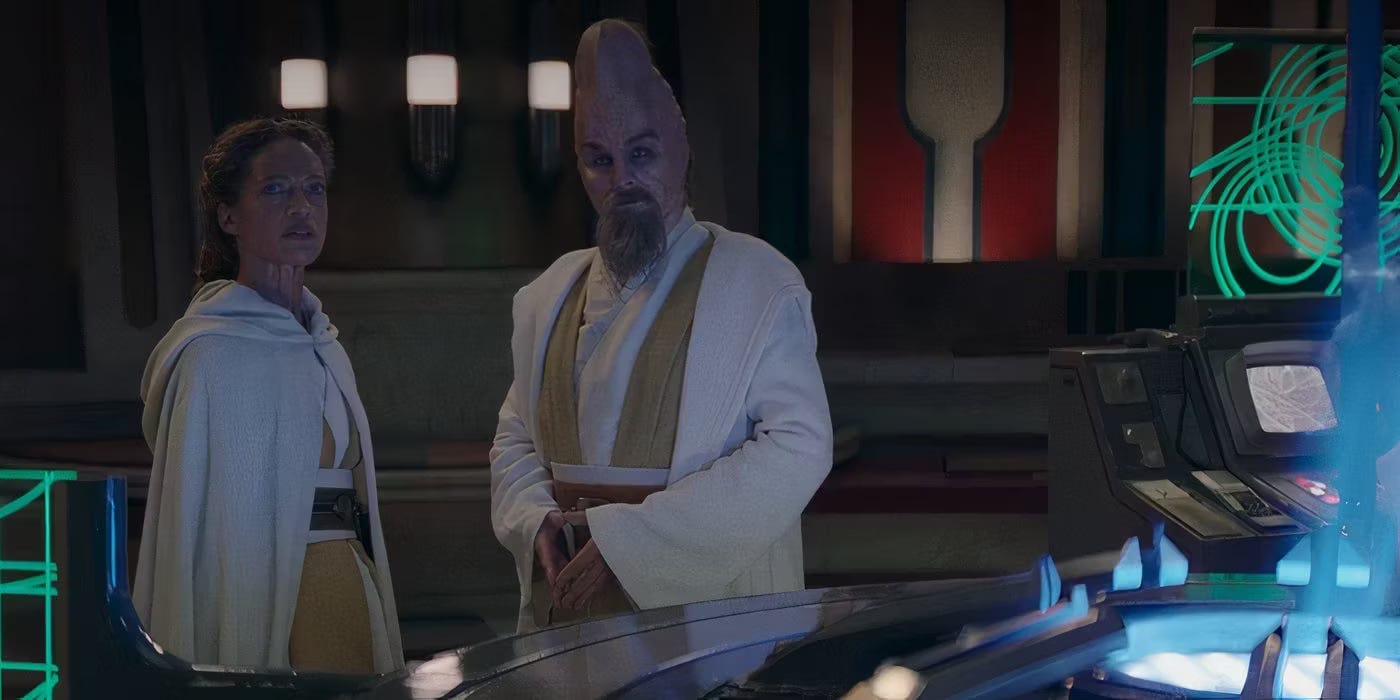
Commenters have also criticized the inclusion of dark-side force users in The Acolyte on the grounds that Mundi himself stated that “the Sith have been extinct for a millenium” in The Phantom Menace. Of course, Mundi was completely wrong and the Sith were right under his nose; the whole point of the quote was to illustrate the overconfidence and myopia of the prequel-era Jedi, which ultimately led to their downfall. So it seems likely to me that Mundi’s appearance in The Acolyte was not just an inconsequential change from Legends, but very intentional inclusion intended to recall his statement in The Phantom Menace.
So what I want to say is this: don’t get bogged down in the details. Cameos and lore tidbits shouldn’t be more important than the larger story and themes of any narrative, Star Wars or otherwise. Engage with books, comics, movies, and TV on more than a surface level and you’ll be rewarded. I personally think The Acolyte is far from perfect, but we’re just over halfway through season one and I believe that TV needs to be considered in whole seasons rather than individual episodes. Go watch the show, give it a fair chance, and if you like it, great! If you don’t, just turn off the TV. There are many more productive and satisfying uses of your time than raging on the internet about Star Wars.